

Which Figure Depicts An Animal Cell Placed In A Solution Hypotonic To The Cell
Chapter 3: Introduction to Jail cell Structure and Function
3.5 Passive Transport
By the end of this section, you will be able to:
- Explain why and how passive transport occurs
- Understand the processes of osmosis and improvidence
- Define tonicity and describe its relevance to passive send
Plasma membranes must allow sure substances to enter and leave a jail cell, while preventing harmful material from entering and essential material from leaving. In other words, plasma membranes are selectively permeable—they allow some substances through but non others. If they were to lose this selectivity, the cell would no longer exist able to sustain itself, and information technology would exist destroyed. Some cells require larger amounts of specific substances than exercise other cells; they must accept a way of obtaining these materials from the extracellular fluids. This may happen passively, as certain materials motility back and forth, or the cell may have special mechanisms that ensure send. Nigh cells expend most of their energy, in the form of adenosine triphosphate (ATP), to create and maintain an uneven distribution of ions on the reverse sides of their membranes. The construction of the plasma membrane contributes to these functions, simply information technology also presents some bug.
The most direct forms of membrane transport are passive. Passive transport is a naturally occurring phenomenon and does non require the cell to expend energy to reach the movement. In passive ship, substances move from an surface area of higher concentration to an area of lower concentration in a process called improvidence. A physical space in which in that location is a unlike concentration of a unmarried substance is said to accept a concentration gradient.
Selective Permeability
Plasma membranes are asymmetric, meaning that despite the mirror image formed by the phospholipids, the interior of the membrane is not identical to the exterior of the membrane. Integral proteins that human activity as channels or pumps work in 1 direction. Carbohydrates, attached to lipids or proteins, are also plant on the outside surface of the plasma membrane. These sugar complexes help the prison cell bind substances that the cell needs in the extracellular fluid. This adds considerably to the selective nature of plasma membranes.
Think that plasma membranes have hydrophilic and hydrophobic regions. This characteristic helps the movement of sure materials through the membrane and hinders the motility of others. Lipid-soluble material tin easily skid through the hydrophobic lipid cadre of the membrane. Substances such as the fat-soluble vitamins A, D, E, and K readily pass through the plasma membranes in the digestive tract and other tissues. Fatty-soluble drugs also gain easy entry into cells and are readily transported into the body'due south tissues and organs. Molecules of oxygen and carbon dioxide have no charge and pass through by uncomplicated diffusion.
Polar substances, with the exception of water, present bug for the membrane. While some polar molecules connect easily with the outside of a cell, they cannot readily pass through the lipid core of the plasma membrane. Additionally, whereas small ions could easily slip through the spaces in the mosaic of the membrane, their charge prevents them from doing so. Ions such as sodium, potassium, calcium, and chloride must accept a special means of penetrating plasma membranes. Uncomplicated sugars and amino acids too need assistance with send across plasma membranes.
Improvidence
Diffusion is a passive process of send. A unmarried substance tends to move from an area of high concentration to an surface area of low concentration until the concentration is equal across the space. You are familiar with diffusion of substances through the air. For case, call back near someone opening a canteen of perfume in a room filled with people. The perfume is at its highest concentration in the canteen and is at its lowest at the edges of the room. The perfume vapor will lengthened, or spread away, from the bottle, and gradually, more than and more people will smell the perfume as information technology spreads. Materials move within the cell's cytosol by improvidence, and sure materials move through the plasma membrane by diffusion (Effigy three.24). Diffusion expends no energy. Rather the different concentrations of materials in different areas are a course of potential energy, and diffusion is the dissipation of that potential energy as materials move down their concentration gradients, from high to low.
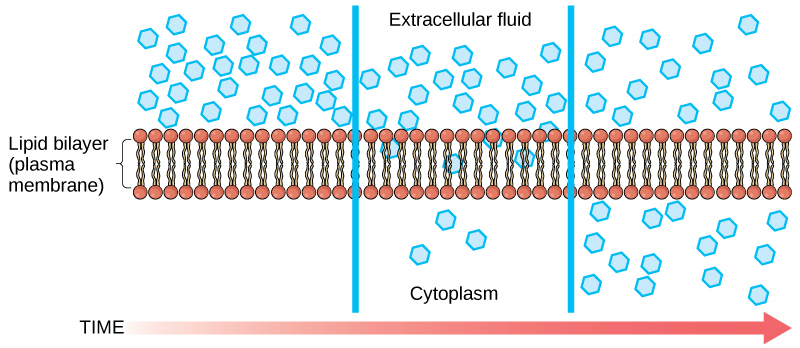
Each split substance in a medium, such as the extracellular fluid, has its own concentration gradient, contained of the concentration gradients of other materials. Additionally, each substance volition diffuse according to that gradient.
Several factors affect the rate of improvidence.
- Extent of the concentration gradient: The greater the divergence in concentration, the more rapid the improvidence. The closer the distribution of the textile gets to equilibrium, the slower the rate of diffusion becomes.
- Mass of the molecules diffusing: More massive molecules move more than slowly, considering it is more difficult for them to movement between the molecules of the substance they are moving through; therefore, they diffuse more slowly.
- Temperature: Higher temperatures increase the free energy and therefore the motility of the molecules, increasing the rate of improvidence.
- Solvent density: Every bit the density of the solvent increases, the rate of diffusion decreases. The molecules boring down because they have a more difficult time getting through the denser medium.
Concept in Action
For an animation of the diffusion process in activity, view this short video on cell membrane transport.

Facilitated transport
In facilitated ship, also called facilitated diffusion, textile moves beyond the plasma membrane with the assist of transmembrane proteins down a concentration gradient (from loftier to low concentration) without the expenditure of cellular energy. Nonetheless, the substances that undergo facilitated ship would otherwise not diffuse easily or quickly across the plasma membrane. The solution to moving polar substances and other substances across the plasma membrane rests in the proteins that bridge its surface. The material existence transported is starting time attached to protein or glycoprotein receptors on the exterior surface of the plasma membrane. This allows the material that is needed by the cell to exist removed from the extracellular fluid. The substances are and so passed to specific integral proteins that facilitate their passage, because they form channels or pores that allow certain substances to pass through the membrane. The integral proteins involved in facilitated transport are collectively referred to as transport proteins, and they function every bit either channels for the cloth or carriers.
Osmosis
Osmosis is the improvidence of water through a semipermeable membrane according to the concentration gradient of water across the membrane. Whereas improvidence transports material beyond membranes and within cells, osmosis transports only water beyond a membrane and the membrane limits the diffusion of solutes in the water. Osmosis is a special instance of improvidence. H2o, similar other substances, moves from an area of higher concentration to one of lower concentration. Imagine a beaker with a semipermeable membrane, separating the ii sides or halves (Effigy 3.25). On both sides of the membrane, the water level is the aforementioned, merely at that place are dissimilar concentrations on each side of a dissolved substance, or solute, that cannot cross the membrane. If the book of the water is the same, but the concentrations of solute are different, then there are also different concentrations of h2o, the solvent, on either side of the membrane.
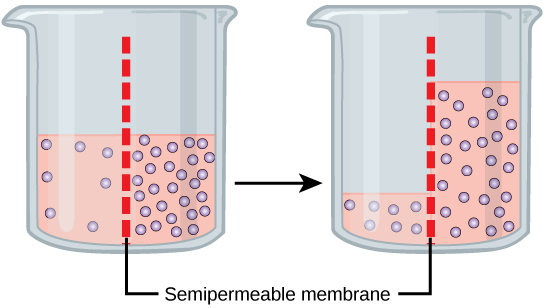
A principle of diffusion is that the molecules move around and will spread evenly throughout the medium if they can. Nonetheless, just the cloth capable of getting through the membrane volition diffuse through information technology. In this example, the solute cannot diffuse through the membrane, only the water can. Water has a concentration slope in this organization. Therefore, h2o will lengthened downwards its concentration gradient, crossing the membrane to the side where it is less concentrated. This diffusion of water through the membrane—osmosis—volition continue until the concentration gradient of water goes to cipher. Osmosis proceeds constantly in living systems.
Tonicity
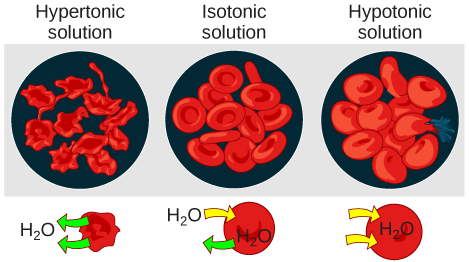
Tonicity describes the amount of solute in a solution. The measure out of the tonicity of a solution, or the total amount of solutes dissolved in a specific amount of solution, is called its osmolarity. Three terms—hypotonic, isotonic, and hypertonic—are used to relate the osmolarity of a jail cell to the osmolarity of the extracellular fluid that contains the cells. In a hypotonic solution, such as tap water, the extracellular fluid has a lower concentration of solutes than the fluid inside the cell, and water enters the jail cell. (In living systems, the point of reference is always the cytoplasm, so the prefix hypo– means that the extracellular fluid has a lower concentration of solutes, or a lower osmolarity, than the cell cytoplasm.) It as well means that the extracellular fluid has a higher concentration of h2o than does the jail cell. In this situation, water volition follow its concentration gradient and enter the cell. This may cause an animal cell to burst, or lyse.
In a hypertonic solution (the prefix hyper– refers to the extracellular fluid having a higher concentration of solutes than the cell'due south cytoplasm), the fluid contains less water than the cell does, such as seawater. Considering the prison cell has a lower concentration of solutes, the water will leave the jail cell. In effect, the solute is cartoon the h2o out of the cell. This may crusade an animal cell to shrivel, or crenate.
In an isotonic solution, the extracellular fluid has the same osmolarity as the cell. If the concentration of solutes of the cell matches that of the extracellular fluid, there volition be no cyberspace motility of water into or out of the prison cell. Blood cells in hypertonic, isotonic, and hypotonic solutions accept on characteristic appearances (Figure three.26).
A md injects a patient with what the doctor thinks is isotonic saline solution. The patient dies, and autopsy reveals that many blood-red claret cells have been destroyed. Do you think the solution the doctor injected was really isotonic?
<!– No, it must have been hypotonic, as a hypotonic solution would cause water to enter the cells, thereby making them burst. –>
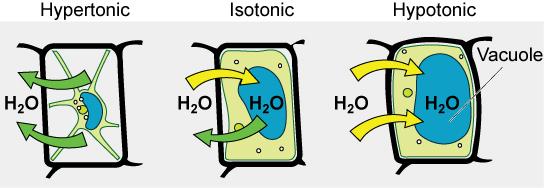
Some organisms, such equally plants, fungi, leaner, and some protists, take cell walls that surround the plasma membrane and prevent cell lysis. The plasma membrane tin simply expand to the limit of the cell wall, and then the cell will not lyse. In fact, the cytoplasm in plants is e'er slightly hypertonic compared to the cellular environment, and water will always enter a cell if water is available. This influx of h2o produces turgor pressure, which stiffens the cell walls of the plant (Figure iii.27). In nonwoody plants, turgor pressure supports the plant. If the establish cells get hypertonic, every bit occurs in drought or if a establish is non watered adequately, water will leave the cell. Plants lose turgor pressure in this condition and wilt.
Department Summary
The passive forms of ship, diffusion and osmosis, motility fabric of minor molecular weight. Substances diffuse from areas of high concentration to areas of low concentration, and this process continues until the substance is evenly distributed in a system. In solutions of more than i substance, each type of molecule diffuses according to its own concentration gradient. Many factors can touch the rate of improvidence, including concentration gradient, the sizes of the particles that are diffusing, and the temperature of the arrangement.
In living systems, diffusion of substances into and out of cells is mediated by the plasma membrane. Some materials lengthened readily through the membrane, but others are hindered, and their passage is only fabricated possible by poly peptide channels and carriers. The chemistry of living things occurs in aqueous solutions, and balancing the concentrations of those solutions is an ongoing trouble. In living systems, diffusion of some substances would be slow or hard without membrane proteins.
concentration gradient: an expanse of loftier concentration beyond from an area of low concentration
diffusion: a passive process of transport of low-molecular weight cloth down its concentration gradient
facilitated transport: a procedure by which cloth moves down a concentration gradient (from loftier to low concentration) using integral membrane proteins
hypertonic: describes a solution in which extracellular fluid has higher osmolarity than the fluid inside the cell
hypotonic: describes a solution in which extracellular fluid has lower osmolarity than the fluid inside the jail cell
isotonic: describes a solution in which the extracellular fluid has the same osmolarity equally the fluid inside the cell
osmolarity: the total corporeality of substances dissolved in a specific amount of solution
osmosis: the transport of water through a semipermeable membrane from an area of high water concentration to an expanse of depression water concentration across a membrane
passive ship: a method of transporting material that does non require energy
selectively permeable: the characteristic of a membrane that allows some substances through but not others
solute: a substance dissolved in another to course a solution
tonicity: the corporeality of solute in a solution.
Media Attributions
- Effigy 3.24: modification of piece of work by Mariana Ruiz Villarreal
- Figure three.26: modification of piece of work by Mariana Ruiz Villarreal
- Figure 3.27: modification of work by Mariana Ruiz Villarreal
Source: https://opentextbc.ca/biology/chapter/3-5-passive-transport/
Posted by: carterwasat1981.blogspot.com
0 Response to "Which Figure Depicts An Animal Cell Placed In A Solution Hypotonic To The Cell"
Post a Comment