

How To Insert A Pause In An Animation After Effects
Get a new perspective on a photograph past separating foreground from background in Adobe Photoshop and adding parallax with a 3D camera in Adobe After Furnishings.
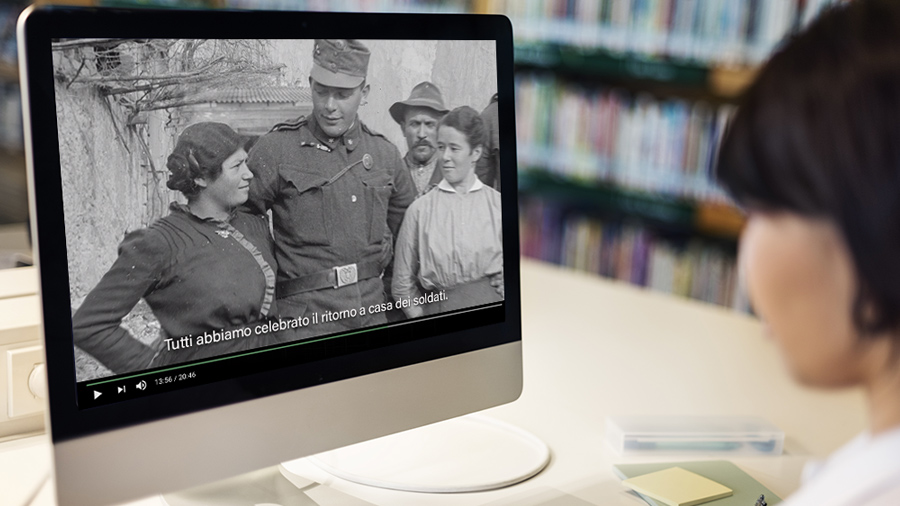
What you'll need
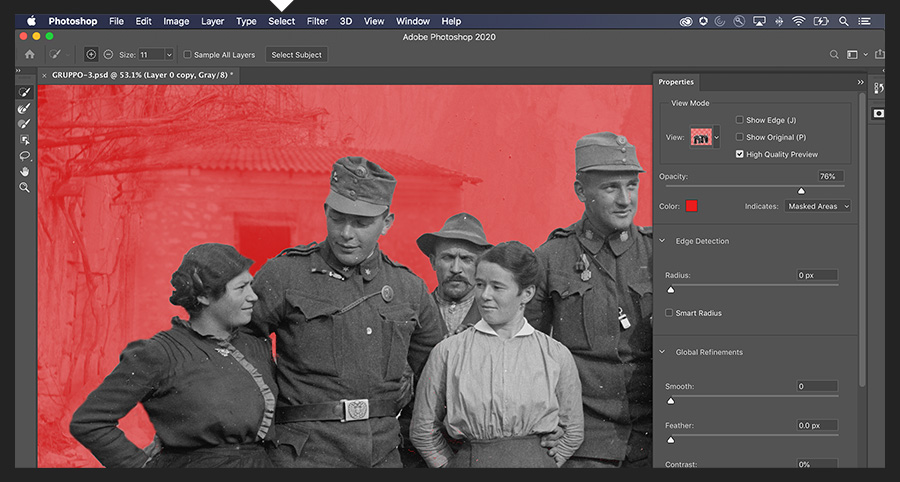
To create a convincing third dimension in a normal photo, start with a high-resolution prototype that contains discrete elements that you can easily split up into foreground and groundwork layers in Photoshop. For example, utilize the Select and Mask workspace (Select > Select and Mask) to isolate figures in the foreground, remove objects with Content-Aware Fill, and retouch photos with selective uses of the Patch tool, Clone Postage tool, or Healing Castor tool. The goal is to isolate objects in the foreground and provide sufficient elements — from one or more photographs — to create a convincing background. In our example, we brought in another photo to supply the missing details in the building.
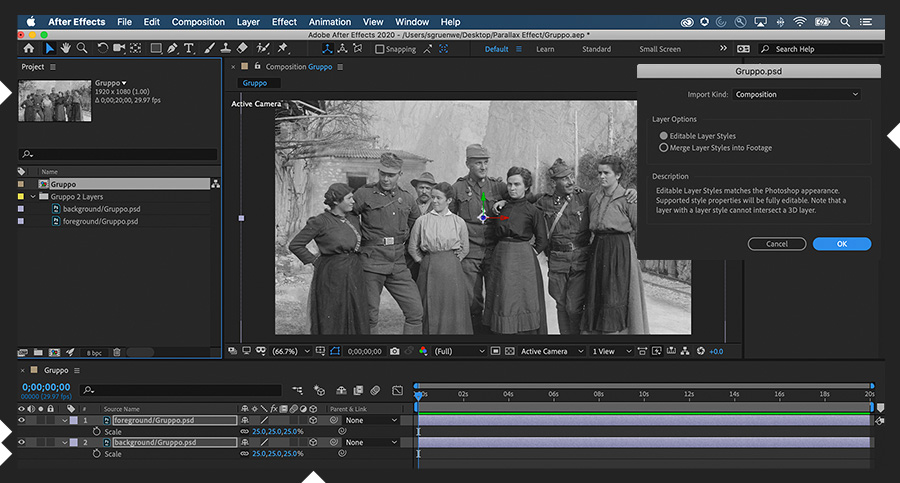
Switching over to Later Effects, import the layered Photoshop file as a Composition and accept the default Editable Layer Styles option in the Import Kind dialog box. Press Command/Control+N to open the Limerick Settings dialog box. Set the dimensions smaller than the photo. Elevate all layers from the imported PSD file into the new composition and then that the background layer is on the bottom. With the layers selected in the Timeline panel, press South to scale them in unison until they fit as you wish in the viewable surface area of the Composition panel. (If necessary, press P to reposition them too.) Finally, click the 3D Layer switch to make them all 3D layers.
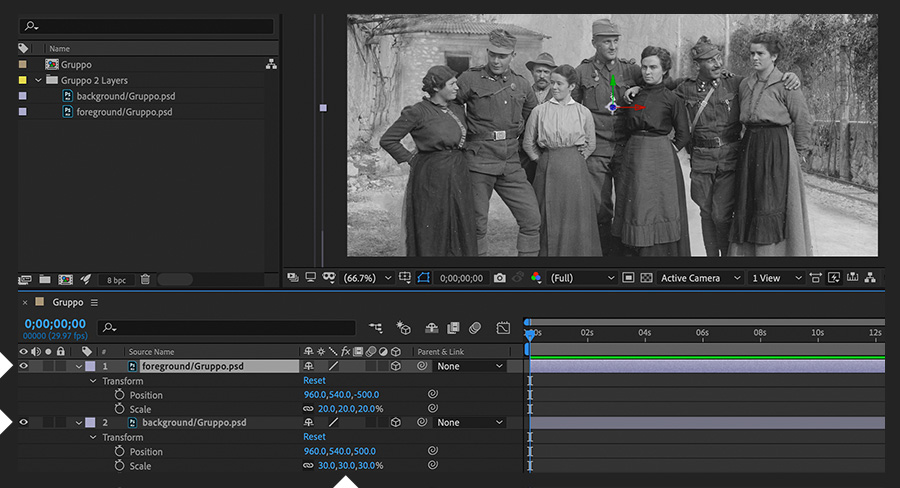
Parallax animation relies on an adequate distance between the 3D layers in z space. Starting with the top layer, press P and position it closer to you in z space (z < 0), so press S and scale information technology back down to normal size. Position the background layer farther away in z space (z > 0) and then scale it up. Whatsoever middle layers can stay where they are or move slightly forrad or backward, depending on the scene. The last epitome should await virtually the same as before except that now there's distance betwixt the layers.
The z-infinite positioning you cull for each layer depends on the relative distance between these objects in the original scene when the photo was taken. To replicate that shot, create a Camera layer (Layer > New > Camera). In the Camera Settings dialog box, set up Blazon to 1-Node Camera and use a Preset focal length that suits the photo.
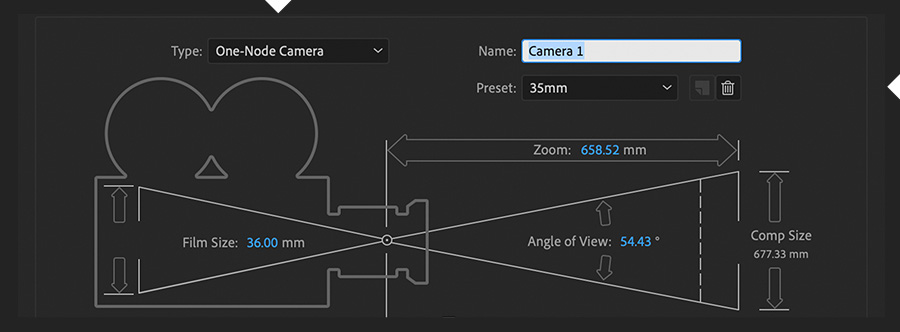
Position the new Photographic camera layer at the top of the Timeline panel. To get a better perspective on the layers' relative positions and understand how the camera's movements affect the final parallax animation, open the View Layout menu at the bottom of the Composition panel and choose two Views. Set one view to Custom View one and keep the other at Agile Camera.
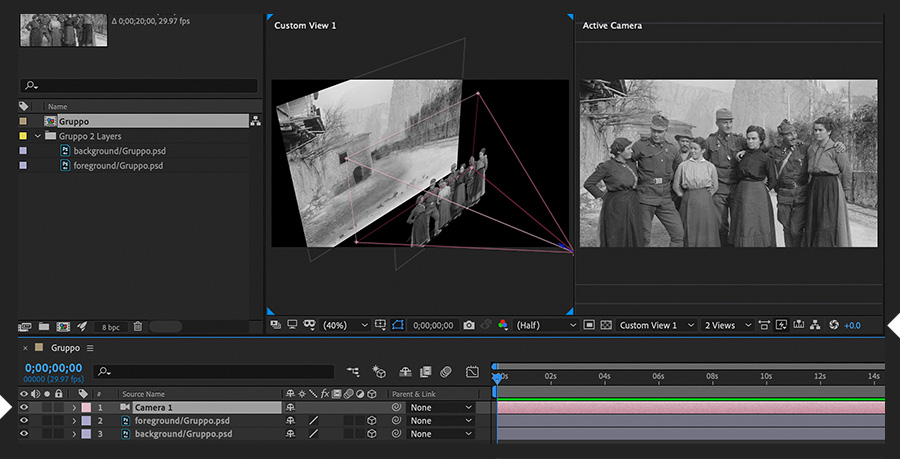
To create the parallax effect, simply animate the camera around 3D space. Twirl down the Transform backdrop for the Camera layer and keyframe Position and Orientation — and whatever other transform controls y'all desire to change over time.
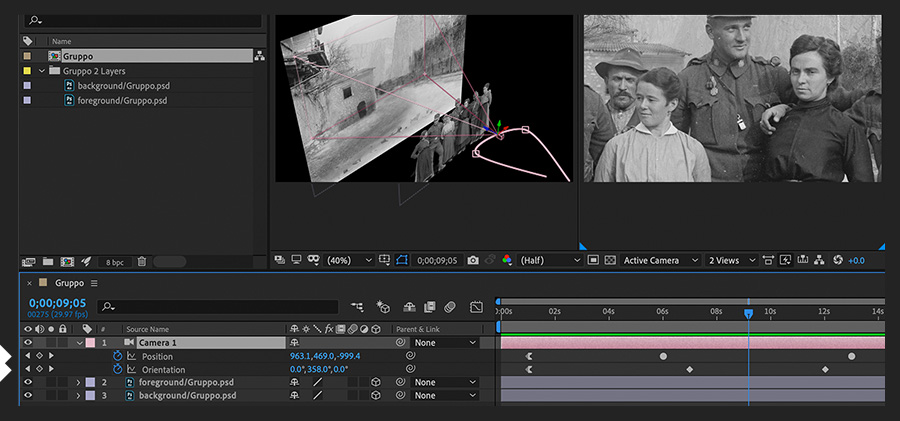
As y'all experiment, yous may have to printing Control/Control+Z repeatedly to undo an unsuccessful photographic camera motion. When y'all similar what you run across, add easing to the keyframes. Command/Control-clicking a keyframe uses Auto Bézier (circle), which can help smooth the charge per unit of change.
With Adobe Stock, y'all accept access to more than 100 million high-quality, royalty-free images including photos, graphics, videos, and templates to jump-showtime your artistic projects. Attempt Adobe Stock and become 10 gratis images.
Source: https://helpx.adobe.com/after-effects/how-to/animate-picture.html
Posted by: carterwasat1981.blogspot.com
0 Response to "How To Insert A Pause In An Animation After Effects"
Post a Comment